HASL vs ENIG vs OSP: Which Surface Finish Should You Pick?
A practical decision guide to PCB surface finishes: match HASL, lead-free HASL, ENIG or OSP to your parts, budget and how long the boards will wait before assembly.
Microplacer team · 15 November 2026 · 5 min read
 PCB Manufacturing
Surface finish is easy to skip past in a PCB order, yet it can decide whether your first assembly run goes smoothly or ends with bridged pins and lifted BGAs. The choice comes down to three questions: what parts are on the board, what you can spend, and how long the bare boards will wait before soldering.
Why pads need a finish at all
Solder mask hides most of the copper, but every pad, test point and contact has to stay open so it can be soldered or touched. Left bare, that copper starts to tarnish within days, and a tarnished pad resists solder: joints come out dull, grainy or simply do not form. A finish is a thin sacrificial or protective coat that holds the pad in a solder-ready state until assembly day.
Whichever finish you pick, it changes three things on your bench:
- Solderability — how readily paste or wire solder flows and bonds to the pad.
- Pad flatness — how level the pad top is, which decides how evenly a stencil deposits paste on small parts.
- Shelf life — how long the bare boards stay easy to solder while they sit in a drawer or a store room.
HASL and lead-free HASL: the dependable workhorse
Hot air solder levelling coats the board in molten solder and then strips the surplus away with jets of hot air. Every exposed pad ends up carrying its own small coat of solder. That makes HASL boards a pleasure to hand solder — the pad is effectively pre-tinned — and they tolerate storage well at a low price.
The catch is flatness. Surface tension leaves the solder slightly domed, and the thickness varies from pad to pad. On a 0805 resistor or an SOIC that hardly matters. On a 0.5 mm pitch QFP, a QFN with a large thermal pad or a BGA, those small height differences can lead to uneven paste deposits, tombstoning or open joints.
Leaded or lead-free?
The tin-lead version is the most forgiving to rework, but lead rules it out wherever RoHS applies. The lead-free version swaps in a lead-free alloy, so it suits RoHS products while staying easy to solder and store. Expect a hotter process and pads that are still domed rather than flat. If your product is sold where RoHS is required, or you would simply rather not handle lead, go lead-free.
ENIG: flat pads for fine pitch and BGA
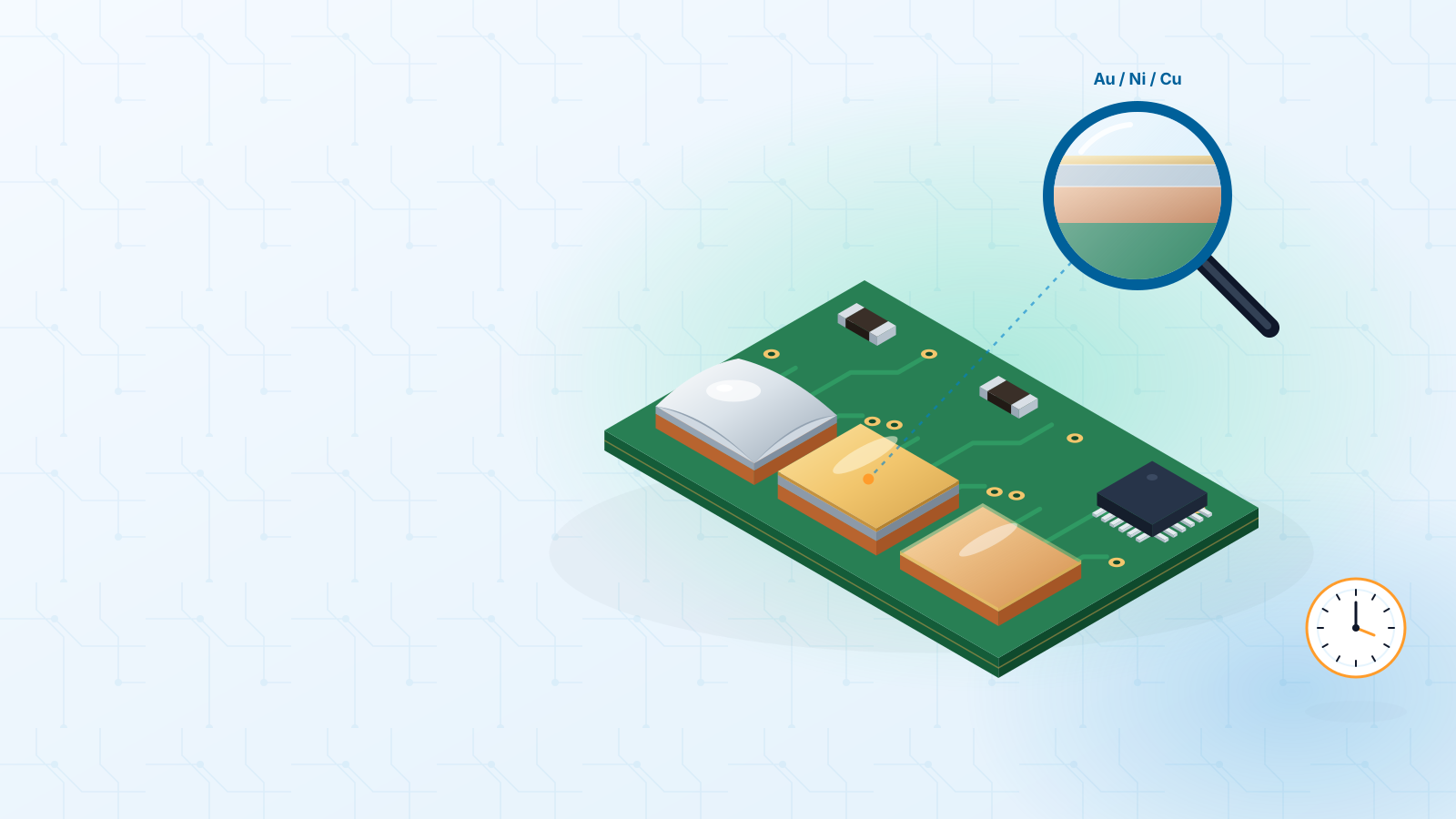
Electroless nickel immersion gold builds a nickel layer on the copper and then a very thin gold layer on top. The gold protects the nickel from oxidising, and the solder joint actually forms on the nickel. The result is a smooth, flat, uniform pad — exactly what fine stencil apertures and tiny packages want.
- Pads come out level, so stencils print evenly on BGAs, QFNs, LGAs, fine-pitch ICs and 0402-size passives.
- Stores well: gold barely reacts with air, so boards can wait months in normal, dry storage.
- Lead-free, and the flat, tarnish-resistant surface also works for membrane keypad and press-contact pads.
- The price is higher, since you are paying for gold and for extra plating chemistry.
One point people often mix up: ENIG is not the same as gold fingers. ENIG is a thin solderable coating; edge connectors that are plugged in and out many times need hard-gold plated fingers, which are ordered as a separate option.
OSP: thin, flat and economical — with handling rules
Organic solderability preservative is a very thin organic film applied to the copper. It leaves the pad as flat as bare copper, contains no lead and is inexpensive, so it is attractive for SMD boards in volume. The film is delicate, though, and that shapes how you use it.
- It ages fastest of the four, so schedule assembly for soon after delivery rather than months later.
- Skin oils and humidity damage the film — leave boards in their sealed bag and hold them by the edges.
- Each trip through the oven weakens it, so plan double-sided reflow and any rework close together.
- The pads look like plain copper, so spotting a problem by eye takes a little more care.
The four finishes at a glance
| Finish | Pads | Lead-free | Keeps well | Cost | Pick it when… |
|---|---|---|---|---|---|
| HASL (tin-lead) | Domed | No | Yes | Low | RoHS does not apply and the board is mostly through-hole or hand soldered |
| Lead-free HASL | Domed | Yes | Yes | Low | You want a cheap, all-round RoHS board with ordinary SMD sizes |
| ENIG | Flat | Yes | Yes | Higher | There are BGAs, QFNs or fine-pitch ICs, or boards will sit in stock |
| OSP | Flat | Yes | Short | Low | An SMD batch goes into assembly almost as soon as it arrives |
Quick decision guide by project type
- 1Hobby or learning board, mostly through-hole, hand soldered: HASL. Choose lead-free if you prefer to avoid lead.
- 2General product prototype with 0603/0805 parts and SOICs: lead-free HASL is a sensible, economical default.
- 3Fine-pitch ICs, QFN thermal pads or any BGA: ENIG. The flat pads are worth the extra cost.
- 4Boards that may sit on a shelf for months, or need contact pads: ENIG.
- 5Pure SMD batch going straight into assembly: OSP gives flat pads at low cost — just keep the boards sealed and assemble promptly.
- 6Flexible PCB: ENIG is the usual choice; check the flex options in the calculator for your board.
Your next step
If you are still unsure, start with lead-free HASL for simple boards and ENIG for anything with fine-pitch or BGA parts. For the full details, including ENIG gold thickness options and which finishes go with which board builds, read our surface finish guide and check the limits on the PCB capabilities page before you order.
#surface-finish#hasl#enig#osp#pcb-manufacturing
Get an instant PCB quote